
Emerging research shows significant improvements in tissue regeneration and reductions in inflammation. PBM uses gentle, non-thermal light to support the body’s natural healing processes at the cellular level. When these wavelengths reach your cells, they stimulate the mitochondria, the energy centers responsible for cellular repair and recovery.
By increasing cellular energy and improving circulation, PBM helps the body calm inflammation and restore healthy function over time.
PBM for Lung Inflammation
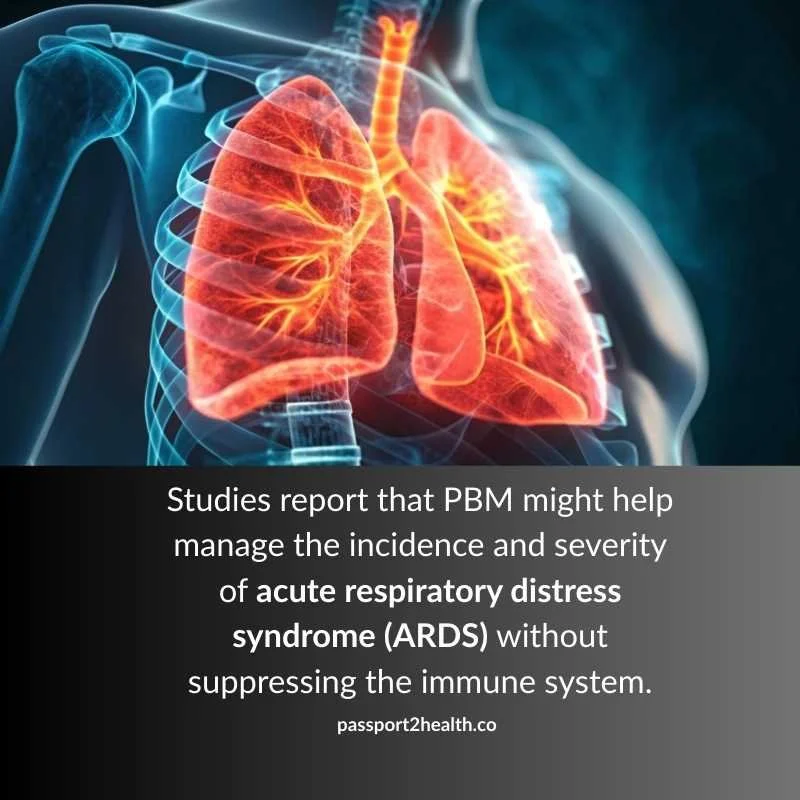
One of the key drivers behind long-haul COVID symptoms is a respiratory complication. This is caused by persistent inflammation, particularly in the lungs and nervous system.
In acute COVID-19, inflammation can become excessive due to a “cytokine storm,” leading to conditions such as acute respiratory distress syndrome (ARDS). This process involves overactivation of immune cells, inflammatory signaling, scar tissue formation, and even changes in the innate immune system, delaying healing and even leading to immune compromise.
Studies report that PBM might help manage these immune responses. This reduces the incidence and severity of ARDS, without suppressing the immune system.
PBM for Loss of Smell and Taste
Loss of smell and taste has been one of the most frustrating lingering symptoms reported after COVID-19.
Clinical findings show that red and infrared wavelengths (660–808 nm) delivered intranasally or intraorally have led to:
Consistent improvement in smell and taste recovery
Better quality-of-life metrics
Positive outcomes even in persistent, long-term cases
This suggests PBM may help stimulate recovery of sensor nerve pathways by reducing neuroinflammation and providing mitochondrial support for energy to recover from a COVID-19 infection, both acute and chronic.
PBM for Cognitive Dysfunction
Many post-COVID patients report cognitive challenges often described as “brain fog,” including memory issues, difficulty concentrating, and mental fatigue. This can be due to neuroinflammation, changes in cerebral perfusion (blood flow to the brain), or misconnections in neuronal mitochondrial activity.
Research indicates that PBM may help by:
Enhancing mitochondrial energy production in neurons
Improving cerebral blood flow
Supporting resolution of neuroinflammation
Support mitochondrial function to help fuel recovery
Both transcranial PBM (1070 nm) and whole-body PBM (660–850 nm) have shown promise in supporting brain function and cognitive recovery.
PBM for Headaches and Orofacial Pain
Post-COVID headaches and facial pain can significantly interfere with daily life. Studies using vascular PBM (660 nm) have demonstrated:
Reduced pain scores
Improved daily activity levels
Better overall comfort in post-COVID headache and orofacial pain sufferers
This makes PBM a compelling drug-free option for ongoing pain management.
PBM for Hair Loss
Another common sequelae is excessive hair loss or an inability to recover from hair loss after COVID-19. In a 2024 study with 140 test subjects, reports indicated faster hair regrowth and cessation of shedding after 12 weeks of red LED therapy.
“Apart from the cessation of hair shedding, LED therapy increases the percentage of thick hair and increases hair density, which all together lead to a clinically and cosmetically accepted improvement”. - AAEM
Although this was a small group of test subjects, a larger study could yield a definitive treatment for telogen effluvium, the most common form of temporary hair loss.
Why Patients and Providers Are Exploring PBM
PBM is widely studied, FDA-cleared for multiple indications, and used globally by healthcare professionals. Sessions are comfortable, non-invasive, and easily integrated into rehabilitation or wellness plans.
Because PBM supports natural recovery processes, it is being explored as a complementary option for long-term COVID rehabilitation.
Find Out if PBM is Right For You
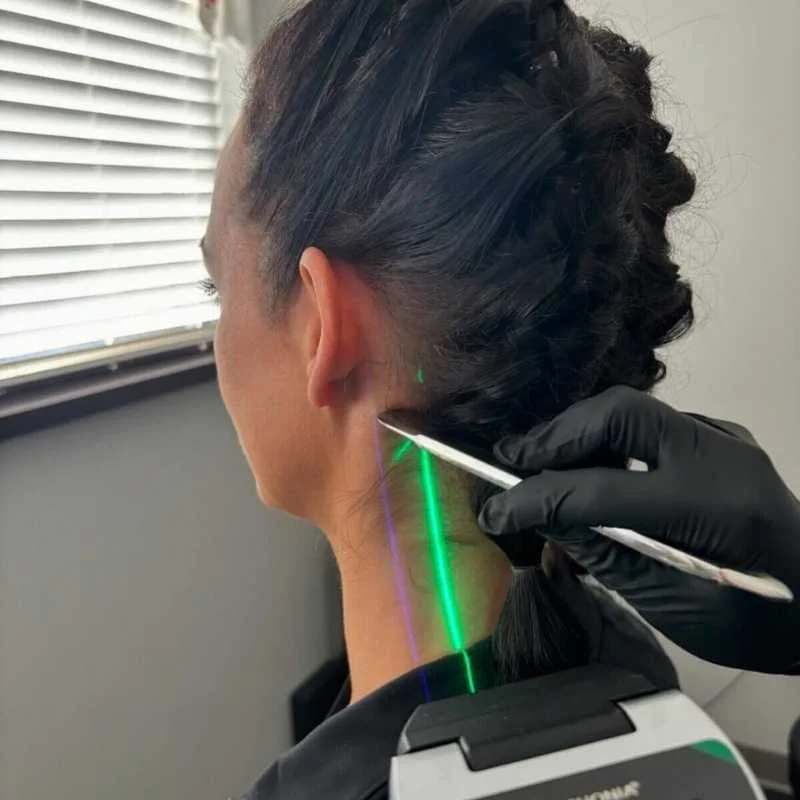
Photobiomodulation, also known as LLLT, offers a safe, non-invasive, and science-backed approach to post-COVID rehabilitation. It supports lung health, neurological recovery, pain relief, and overall healing. If you’re struggling with lingering symptoms after COVID-19, PBM may be worth exploring as part of a personalized recovery plan.
You can start by scheduling a telemedicine consultation with Dr. Gaston to learn whether light-based laser therapy may be appropriate for your needs and to discuss options for in-clinic or guided at-home use.
Wellness is not a luxury; it's a priority.
See how we use PMB or LLLT to treat anxiety, fatigue, chronic pain, hair loss, inflammation, and more: https://www.passport2health.co/laser-rental
Sources
Cury V, de Lima TM, Prado CM, Pinheiro N, Ariga SK, Barbeiro DF, Moretti AI, Souza HP. Low level laser therapy reduces acute lung inflammation without impairing lung function. J Biophotonics. 2016
Mussttaf RA, Jenkins DFL, Jha AN (2019). Assessing the impact of low-level laser therapy (LLLT) on biological systems: a review. Int J Radiat Biol 95:120–143
Panhoca VH, Ferreira LT, de Souza VB, Ferreira SA, Simão G, de Aquino Junior AE, Bagnato VS, Hanna R. Can photobiomodulation restore anosmia and ageusia induced by COVID-19? A pilot clinical study. J Biophotonics. 2023 Jun;16(6):e202300003. doi: 10.1002/jbio.202300003. Epub 2023 Mar 22. PMID: 36929335.
Nairuz T, Sangwoo-Cho, Lee JH. Photobiomodulation Therapy on Brain: Pioneering an Innovative Approach to Revolutionize Cognitive Dynamics. Cells. 2024 Jun 3;13(11):966. doi: 10.3390/cells13110966. PMID: 38891098; PMCID: PMC11171912.
Annals of Agricultural and Environmental Medicine 2024, Vol 31, No 2, 239–247
Gerkowicz A, Bartosińska J, Krakowski P, Karpiński R, Krasowska D, Raczkiewicz D, Kwasny M, Krasowska D. Red LED light therapy for telogen effluvium in the course of long COVID in patients with and without androgenetic alopecia. Ann Agric Environ Med. 2024 Jun 27;31(2):239-247. doi: 10.26444/aaem/177238. Epub 2024 Jan 8. PMID: 38940108.
